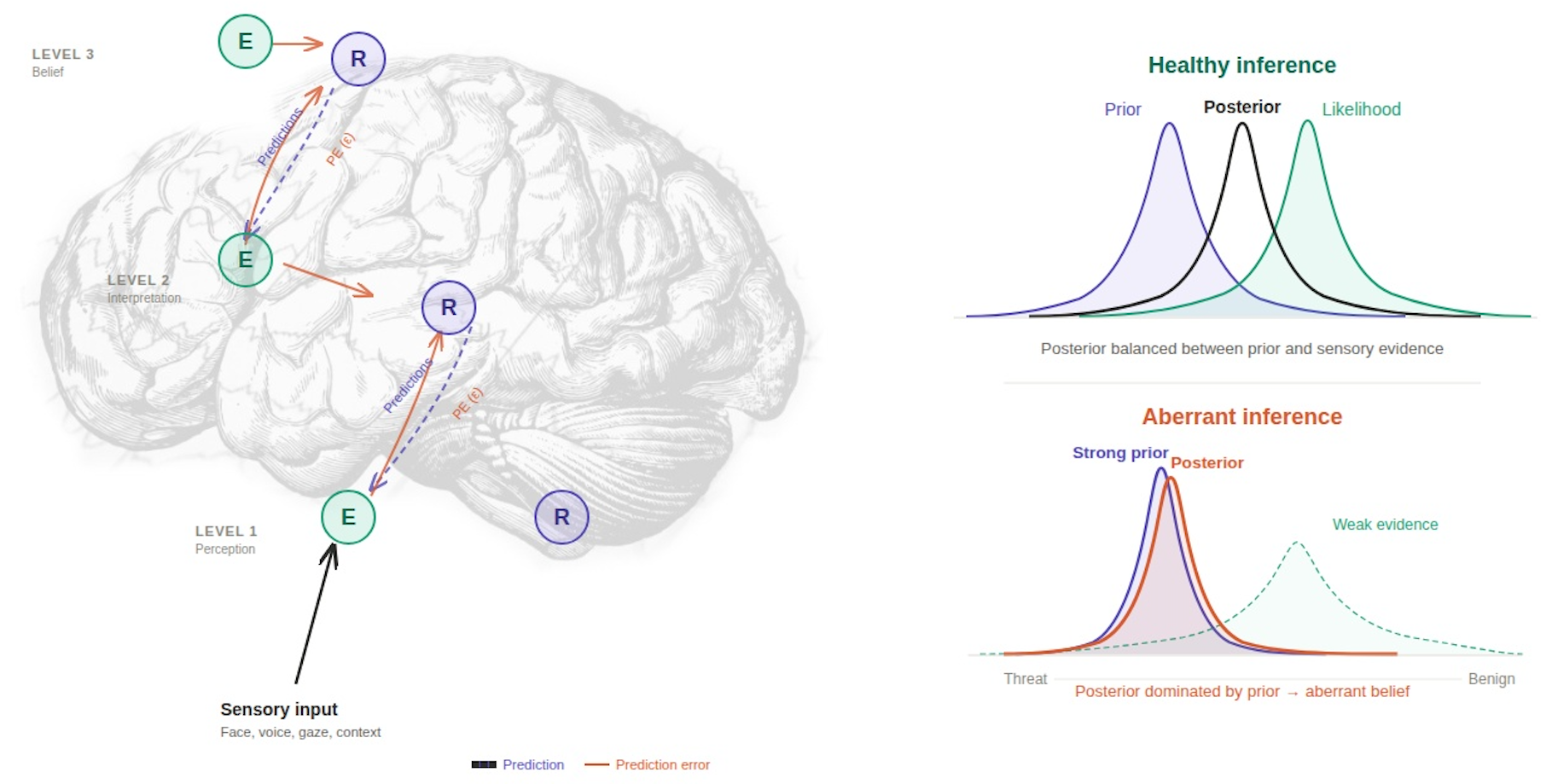
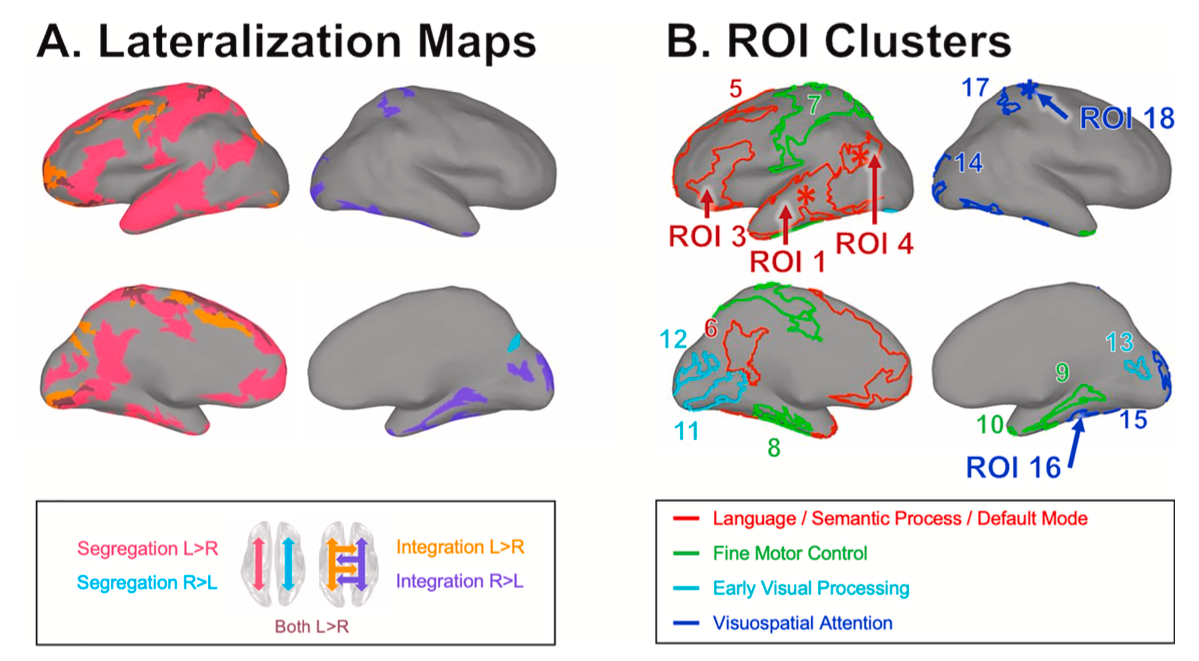
The Computational Psychiatry Laboratory (CPL) at Kyungpook National University School of Medicine investigates how the brain constructs its model of the world — and how that process goes wrong. Our central question is why certain individuals come to misread social signals, form unfounded beliefs, and ultimately develop delusions, while others exposed to comparable risk do not. We approach this as a problem of computational inference: the brain continuously generates predictions about the environment, and psychosis may arise when the mechanisms governing belief updating and error correction break down.
To study this question, we follow individuals along the psychosis continuum — from clinical high-risk states through first-episode psychosis and established schizophrenia — treating the transition to psychosis as a natural experiment in aberrant belief formation. Our longitudinal cohorts allow us to track cognitive, social-cognitive, and neurobiological changes as they unfold, rather than reconstructing them retrospectively. This work draws on computational modeling, multimodal neuroimaging, and detailed neuropsychological assessment.
Alongside this program, we conduct clinically oriented research on treatment response and resistance in psychotic disorders, including pharmacological studies on clozapine mechanisms and investigations using non-invasive brain stimulation techniques such as transcranial electrical stimulation, vagus nerve stimulation, and focused ultrasound.
Join us!
Our laboratory is always looking for motivated individuals to join our research team. We welcome inquiries from prospective students at all levels — Master’s, Doctoral, and integrated MS-PhD programs — through the Department of Medical Sciences, KNU Graduate School. Undergraduate students interested in a research internship are also encouraged to reach out.
If you are interested in joining us, please contact Prof. Taeyoung Lee at tylee@knu.ac.kr with a brief description of your background and research interests.
Please note that some graduate courses are offered exclusively in Korean. International applicants to degree programs are therefore expected to have a working proficiency in Korean. If you are an international researcher interested in non-degree collaboration or a short-term visit, please feel free to inquire regardless of language background.